Evaluating the humanities — FWO postdoctoral research
Up to now, the history of peer review in the humanities has been almost entirely overlooked. Since peer reviewing is a crucial gatekeeping activity in academic contexts, historians’ lack of attention for this practice is — to say the least — somewhat strange. But what makes the lack of historical attention for peer review even stranger is that the entire system and idea of peer review underwent significant changes in the last seventy years. Since the 1950s, assessment at grant agencies, within editorial boards, and in hiring committees evolved from being more informal and flexible to becoming blind, bureaucratic, and highly formalized. But why? And to what effects?
To some extent, the story of how this happened has been written by historians of science, as well as sociologists of knowledge. The first bureaucratic systems of peer review arose in the 1950s in private and national grant agencies in the USA, and after the term ‘peer review’ was coined in the US medical sciences in the 1970s, blind review practices spread to other disciplines and geographical contexts. This story, however, is not well adapted to the humanities, as definitions of quality, discourses and practices of evaluation, and scholarly norms and values are different in humanities contexts. Both for historians of peer review and for historians of the humanities, the current lack of research on peer review in the humanities is therefore problematic. Evaluation infrastructure after all determines how we think of what is being evaluated, and peer review may thus have co-defined what the very “humanities” are.
In this, project I therefore address the history of various forms of scholar-to-scholar evaluation in three European funding institutions and one humanities journal.

Cornelius Norbertus Gijsbrechts, Trompe l’oeil of an open cupboard, 1665. Private collection.
-
This project grew out of a collaboration I started with Sjang ten Hagen, who is a historian and philosopher working as Associate Professor at the School of Liberal Arts of Utrecht University. Our joint work on the history of book reviewing (see Sjang’s article on this topic) and the history of grant review (see my dissertation) made us realize that we actually know very little about peer review in the humanities. In April 2024, we therefore launched a call with the journal Minerva to make a theme issue around the topic. In 2026, we are organizing a workshop together with Joris Vandendriessche and Els Minne in Leuven to further investigate links between the history of peer review in the sciences and humanities.
I then went on to design a project that delves deeper into the twentieth-century history of peer review, which was funded by the FWO—Research Foundation Flanders in October 2024 (project ID 1205125N). The project is hosted at Ghent University. If you would like to take a look at the FWO grant application I wrote on the project, feel free to download it here. In my dissertation about the history of research funding, I was able to demonstrate that access to successful funding applications is a key factor predicting success. I therefore refuse to limit access to my own application to my direct network and am happy to answer queries about the application and evaluation process.
-
Marie-Gabrielle Verbergt and Sjang ten Hagen, “The Past and Present of Peer Review in the Humanities: An Introduction”, Minerva—A Review of Science, Learning and Policy, 63, no. 4 (2025): 637–657.
Sjang ten Hagen and Marie-Gabrielle Verbergt (eds.), The Past and Present of Peer Review in the Humanities, Minerva—A Review of Science, Learning and Policy, 63, no. 4 (2025): 637–801.
-
Seminar “Peer Review in the Humanities: Evaluative Practices from the 19th to the 21st Century”, with Isak Hammar and Hampus Östh Gustaffson, Lund Centre for the History of Knowledge, 17 March 2025.
Conference presentation “The History of Peer Review in the Humanities (2 panels)”, with Sjang ten Hagen, Lund Centre for the History of Knowledge, Lund, 9-11 October 2024.
Colloquium “Trust in peers”, with Floris Cohen and Tessa van Charldorp, Trust in Science Colloquium, Descartes Centre for the History and Philosophy of the Sciences and the Humanities, Utrecht University, 19 November 2024.
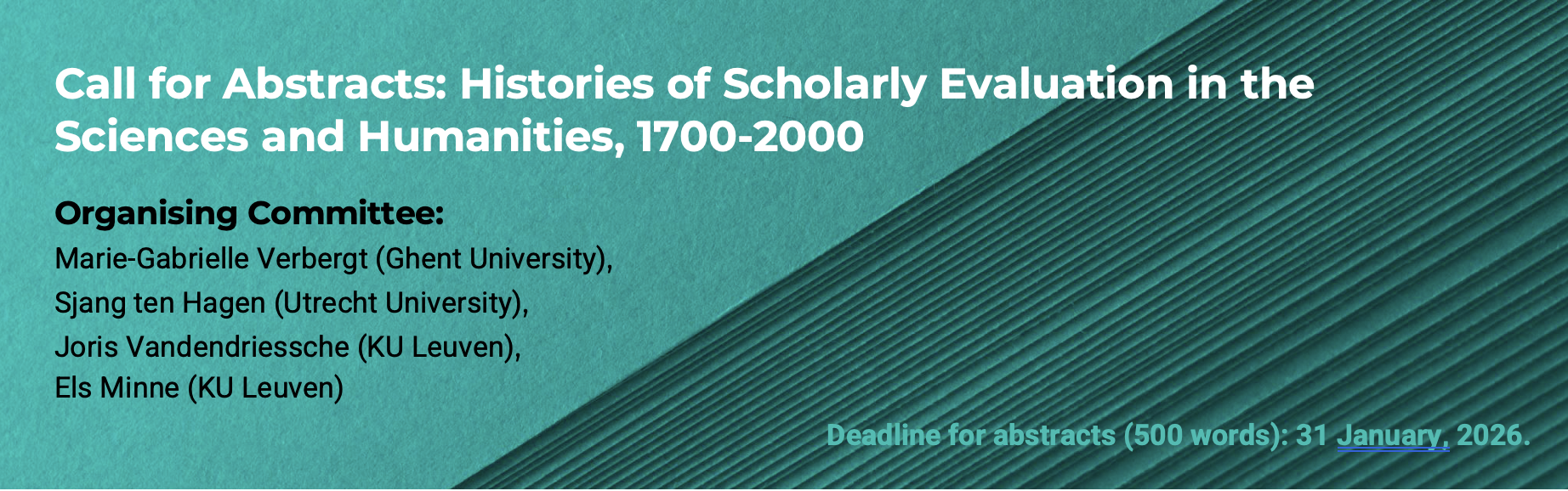
Call for Abstracts for a workshop I am co-organising on Histories of Scholarly Evaluation in the Sciences and Humanities, 1700-2000 (Leuven, 27-29 September, 2026). Deadline 31 January 2026. More information here.